


Quality Management
Quality comes from every fibre
ChenYang is a specialised nonwovens manufacturing company and as such we have dedicated quality control departments at every stage of production to ensure the quality of the products we supply. Our quality control and manufacturing departments work in tandem at every stage and process, including raw materials, finished products, inspection and packaging processes - working together to ensure the quality of the final product.

Our Inspection Programme
Appearance Inspection
Chemical Performance Testing
Packaging and Labeling
Quality Control Documentation
Functional Testing
Dimensions and Cutting
Special Testing
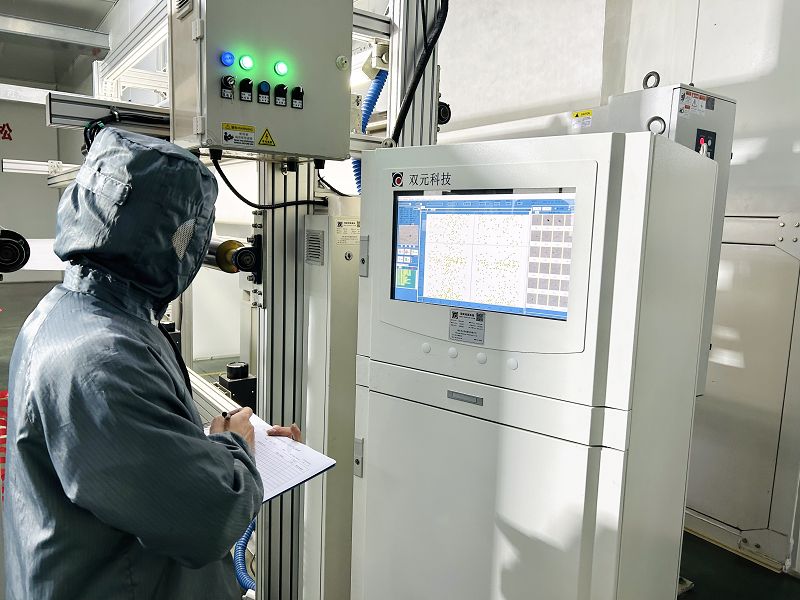
Physical and chemical examination
High-quality nonwovens are not only the result of efficient production, they are also the basis for meeting customers' needs in multiple scenarios. To ensure that every piece of nonwoven fabric has excellent water absorption, strength and environmental friendliness, we strictly carry out grammage tests, thickness tests and surface uniformity checks during the production process. Only by passing these strict functional criteria can the product be safely and efficiently delivered from the nonwoven production plant to the customer.

Ensuring quality takes a team effort
Producing quality nonwovens is a team effort that requires the support of line operators, cleaning and changeover personnel and manufacturing/packaging managers. The raw materials used are carefully screened. Our QC team carefully tracks the thickness, uniformity and colour of the material. During the production of tablecloths, they will carefully check the size, folding and packaging of each product. Ensuring that all products meet your requirements before shipment, all ChneYang products are SGS and Oekotex certified. Enabling us to faithfully meet your specifications.
| Inspection Item | Details | Purpose and Function |
| Raw Material Inspection | ||
| Fiber Composition and Ratio | Check the ratio of polyester, wood pulp, viscose, PP, etc. | Ensure material performance meets product design requirements. |
| Fiber Quality | Evaluate fiber length, strength, and purity | Ensure uniformity and stability of raw materials. |
| Moisture Content | Measure the moisture content of raw materials | Prevent quality fluctuations during production. |
| Physical Performance Testing | ||
| Basis Weight | Verify the weight per unit area is within the allowable range | Ensure consistent thickness and meet customer requirements. |
| Thickness | Check the consistency of fabric thickness | Improve product uniformity and usability. |
| Tensile Strength | Test longitudinal and transverse tensile strength | Ensure durability to avoid breakage during use. |
| Elongation | Test fabric elasticity | Ensure flexibility for various applications. |
| Tear Strength | Test resistance to tearing | Enhance wear resistance and product lifespan. |
| Appearance Inspection | ||
| Surface Uniformity | Check for spots, holes, or wrinkles on the surface | Ensure high product quality and avoid customer complaints. |
| Color Consistency | Check if the color meets the standard and has no obvious color difference | Improve product aesthetics and market competitiveness. |
| Texture and Pattern | Check if grid or other patterns are clear and uniform | Ensure the product meets design requirements. |
| Functional Testing | ||
| Absorbency | Test absorption speed and capacity | Ensure cleaning performance meets requirements. |
| Waterproof/Breathability | Test resistance to water and breathability | Meet specific application needs. |
| Static Resistance | Test antistatic properties | Suitable for industrial and medical applications. |
| Fluorescence Detection | Check for harmful fluorescent agents | Ensure safety for skin and environmental use. |
| Chemical Performance Testing | ||
| pH Level | Measure the acidity or alkalinity | Ensure safety for skin and the environment. |
| Residual Substances | Test for chemical residues, such as adhesives or detergents | Avoid negative impacts on users or the environment. |
| Antibacterial Properties | Test for antibacterial effectiveness | Meet requirements for medical or household cleaning. |
| Lint Rate Testing | Evaluate the lint shedding rate | Ensure suitability for applications requiring low lint, such as industrial cleaning. |
| Dimensions and Cutting | ||
| Size Tolerance | Verify length and width are within specifications | Ensure consistency and ease of use. |
| Edge Neatness | Check if cutting edges are smooth | Improve product appearance and quality. |
| Packaging and Labeling | ||
| Packaging Integrity | Ensure the package is sealed | Prevent contamination or damage during transport and storage. |
| Label and Specification Consistency | Verify specifications, batch numbers, etc., on labels | Improve product traceability. |
| Quantity Check | Confirm the quantity matches the specifications | Avoid customer dissatisfaction due to shortages. |
| Special Testing | Conduct specific tests such as high-temperature resistance, biodegradability, or flame retardancy | Ensure suitability for specialized applications. |
| Quality Control Documentation | Verify production records, inspection reports, and certifications (ISO, SGS, etc.) | Improve product management and ensure traceability. |